Promote product launches, funding news, and innovations in 75+ countries by reaching top tech journalists and global publications.
Drive international attention to destinations, campaigns, and services by distributing news to relevant travel and lifestyle media worldwide.
Increase visibility of new products, campaigns, and brand stories by connecting with influential retail and consumer-focused media outlets.
Strengthen your crypto brand’s credibility through targeted PR in tech, finance, and blockchain media across global markets.
Expand your agency’s services with global PR distribution in 75+ countries, featuring guaranteed coverage, localized press releases, and white-label reporting for your clients.
M&A Communication: How Private Companies Should Announce a Merger or Acquisition
M&A communication is the planned way a company tells its stakeholders such as employees, customers, partners, regulators and the media that it is merging with or acquiring another business. A private company has more freedom than a publicly traded one, because no stock exchange rule sets the hour of the announcement. That freedom also means there is no ready script. The company has to design the sequence itself. As many deals also cross a border, the announcement often has to work in more than one country and language.
This guide explains how the rules differ for private companies, who should hear the news first, how to prepare for a possible leak, what a merger or acquisition press release contains, with a template, and how to announce a deal in several countries on the same day. This guide and its sample texts describe communication practice and do not constitute legal advice.
What Is M&A Communications?
M&A stands for mergers and acquisitions. M&A communications or merger and acquisition communications is the set of messages, documents and timings a company uses to announce a deal and to explain what changes afterwards. It starts before signing, when the deal is still confidential, and continues through closing and the first months of integration.
The work has two halves. Internal communications covers the employees of both companies, their managers and, where the law provides for it, their representatives. External communications covers customers, suppliers, partners, lenders, regulators and the media. The merger announcement that the public sees, usually a press release, is the last step of a sequence that began with a list of names and a schedule.
An editor who receives a deal announcement asks one question: what changes, and for whom? A buyer that can answer it for employees, customers and the market in the same hour has an M&A communication plan.
Why Private Companies Announce Differently from Listed Companies
Private companies announce differently because no securities law tells them when to speak, and most deals are private. Global M&A volume reached 4.6 trillion US dollars in 2025, 45 percent more than in 2024, and cross-border deals accounted for 1.4 trillion dollars of it, or 30 percent (XBMA Annual Review 2025, based on LSEG data, February 2026). More than 97 percent of the deals recorded on the Bloomberg Terminal in the first half of 2025 involved a private target (Bloomberg, Private Company M&A Chartbook, 2025).
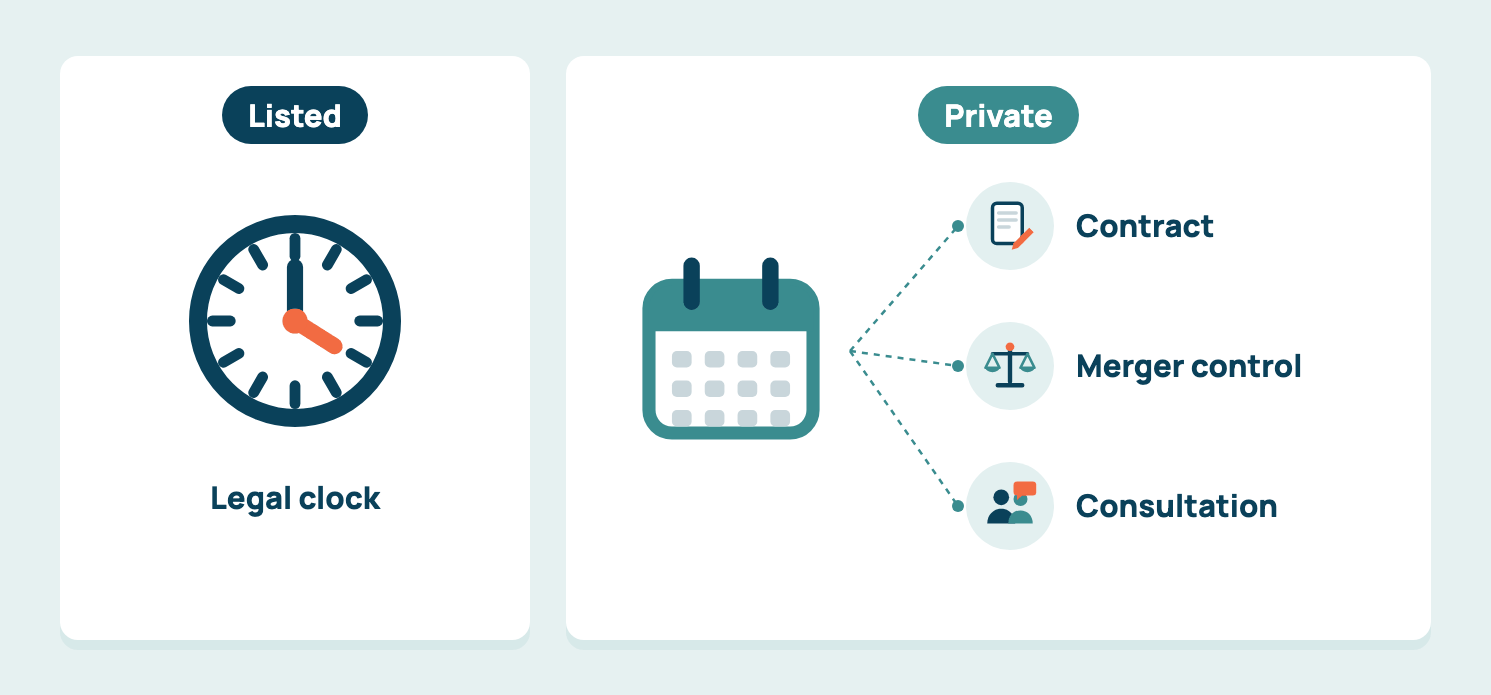
A listed company works to a legal clock. In the United States, a company that signs a material agreement files a Form 8-K within four business days (SEC, Form 8-K, General Instructions). In the European Union, an issuer must disclose inside information as soon as possible (Market Abuse Regulation, Article 17).
Question
Listed company
Private company
Who sets the announcement time?
Securities law and the stock exchange
The parties in the purchase agreement
Must the price be disclosed?
Usually, when the deal is material
No, the parties decide
What forces early disclosure?
Inside information rules, market rumors
Merger control filings, employee consultation, leaks
Who is the first audience?
The market
Employees
Three things still limit a private company.
Contract: Most purchase agreements require both parties to agree on any public statement, so the press release is negotiated together with the deal.
Merger control: In the United States, since 17 February 2026 a transaction above 133.9 million dollars generally requires a premerger filing, and the filing itself is confidential (FTC notice in the Federal Register, January 2026; Clayton Act, Section 7A(h)). In the European Union, the Commission publishes the fact of a notification and the names of the parties (EU Merger Regulation, Article 4(3)). A notified deal can therefore become public on the regulator's schedule.
Employment law: In several countries, employees have a right to be consulted before the decision is final.
Who Should Hear About a Merger or Acquisition First?
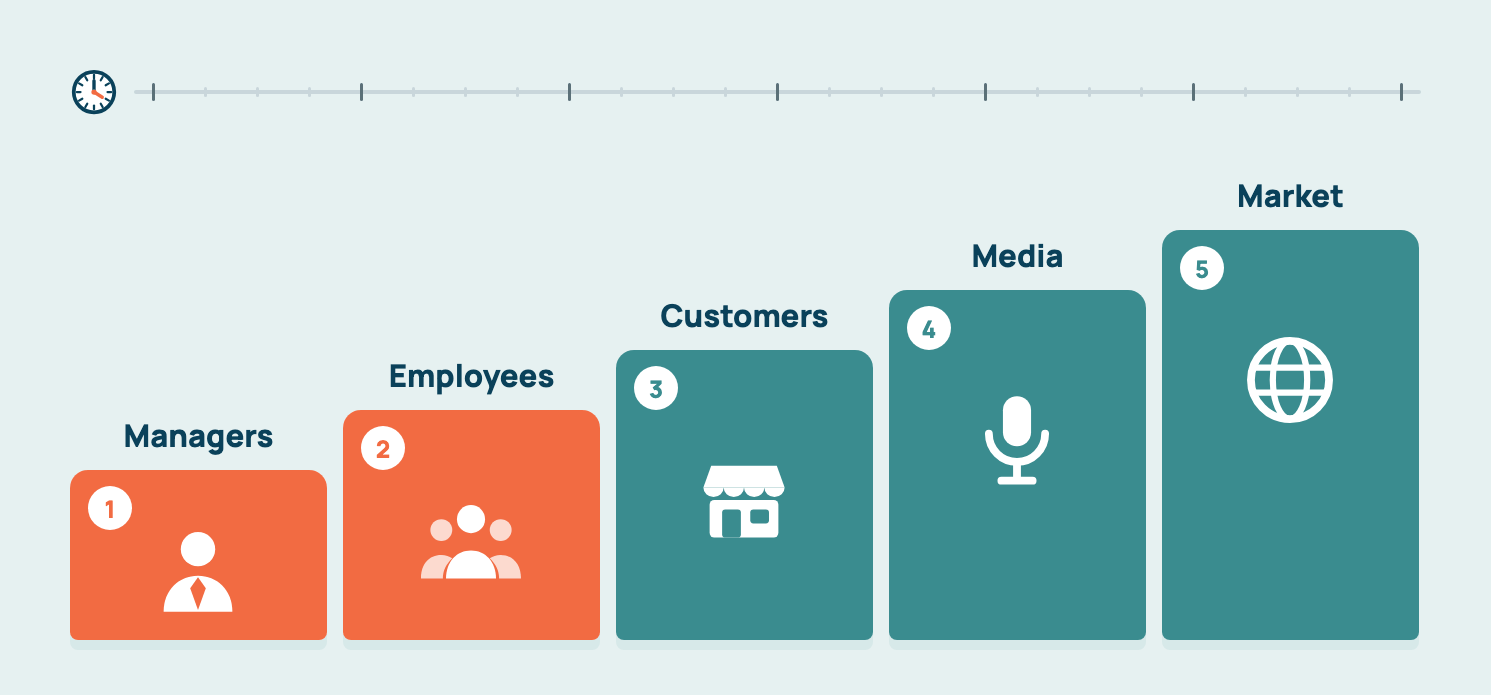
The people whose working lives change hear the news before the people who report on it. For a private company, that means employees first, key customers and partners second, the media third and the wider market last, all within a few hours on the same day.
A first note to employees can be this short:
"Today we signed an agreement under which [Buyer] will acquire [Company]. Until the transaction closes, nothing changes in your contract, your manager or your pay. [What changes after closing, and what is not yet decided.] I will update you on [date], and your manager has a written Q&A as of this morning."
Each bracket is filled with the facts of the deal.
Audience
What they need to know
Channel
When
Senior managers of both companies
The facts, their role, the questions they will get
Briefing in person or by video call, with a written Q&A
Preferably at least 2 to 3 days in advance or the evening before the day
Employees of both companies
What changes for jobs, reporting lines, pay and location, and what is not yet decided
Meeting led by the chief executive, then a written note
Before the press release goes out
Key customers and partners
Whether contracts, contacts, prices and service levels change
Personal call or email from the account owner
Within the first hour
Media
The news fact, the reason, the people
Press release and spokesperson
At the agreed release time
Suppliers, lenders, wider market
Who to invoice, who to call
Letter, website, social channels
Same day
The order protects trust. An employee who reads about the sale of the company on a news portal realizes that the company told journalists first. A customer who hears it from a competitor's sales team gets the competitor's version. An acquisition announcement to employees works when it comes from the chief executive, when it states honestly which decisions are still open and when it gives a date for the next update.
Some countries turn this order into law. In the Netherlands, a company with a works council, which is required from 50 employees, must ask the council for advice on a planned transfer of control, at a time when the advice can still influence the decision (Works Councils Act, Article 25).
In a legal merger or a transfer of a business, EU Directive 2001/23/EC requires the seller to inform employee representatives in good time before the transfer, and the buyer to inform its own before its employees are affected (Article 7). These steps happen under confidentiality and well before announcement day, so they belong in the timeline from the start.
Each audience gets its own document, written from one approved set of facts. This is the structure of any corporate communication plan: the message stays the same while the emphasis changes with the reader.
What Should You Do If the Deal Leaks Before the Announcement?
A leak plan is written before signing, because the number of people who know about a deal grows every week. Advisers, lenders, due diligence teams and translators all join the circle. Among listed targets, where a leak shows in the share price, 8.9 percent of global deals leaked before announcement in 2025. The rate was 9.5 percent in 2024, the highest since the study began in 2009, and the average since then is 8.2 percent (SS&C Intralinks and Bayes Business School, 2026 M&A Deal Leaks Report).
A private company has no share price to give the secret away. Its leaks travel through people, and they reach employees and customers first.
Three preparations limit the damage:
A written list of everyone who knows, with the date each person was told.
A holding statement of two or three sentences, approved by both parties, that can be issued within an hour.
A short version of the full announcement that can go out the same day if the story spreads.
Before signing, the holding statement can be one sentence:
"We do not comment on market speculation."
After signing, it can read:
"[Buyer] and [Target] confirm that they have signed an agreement. Completion is subject to [approvals]. Both companies will publish the full announcement later today."
When a journalist calls before the announcement, there are two honest answers. If nothing is signed, the company does not comment on market speculation. If the agreement is signed, the parties bring the announcement forward. Denying a signed deal is not an option, because the denial becomes a second story a week later. A leak response is a planned reactive statement, and the difference between the two modes is explained in proactive PR and reactive PR.
Confidentiality also shapes the wording after signing. Until closing, the two companies remain separate businesses, and in many deals they remain competitors. Statements describe what will happen after closing and say that the transaction is subject to approval, where that is the case. A sentence that presents the companies as already operating together creates a legal risk under merger control rules.
Should You Announce at Signing or at Closing?
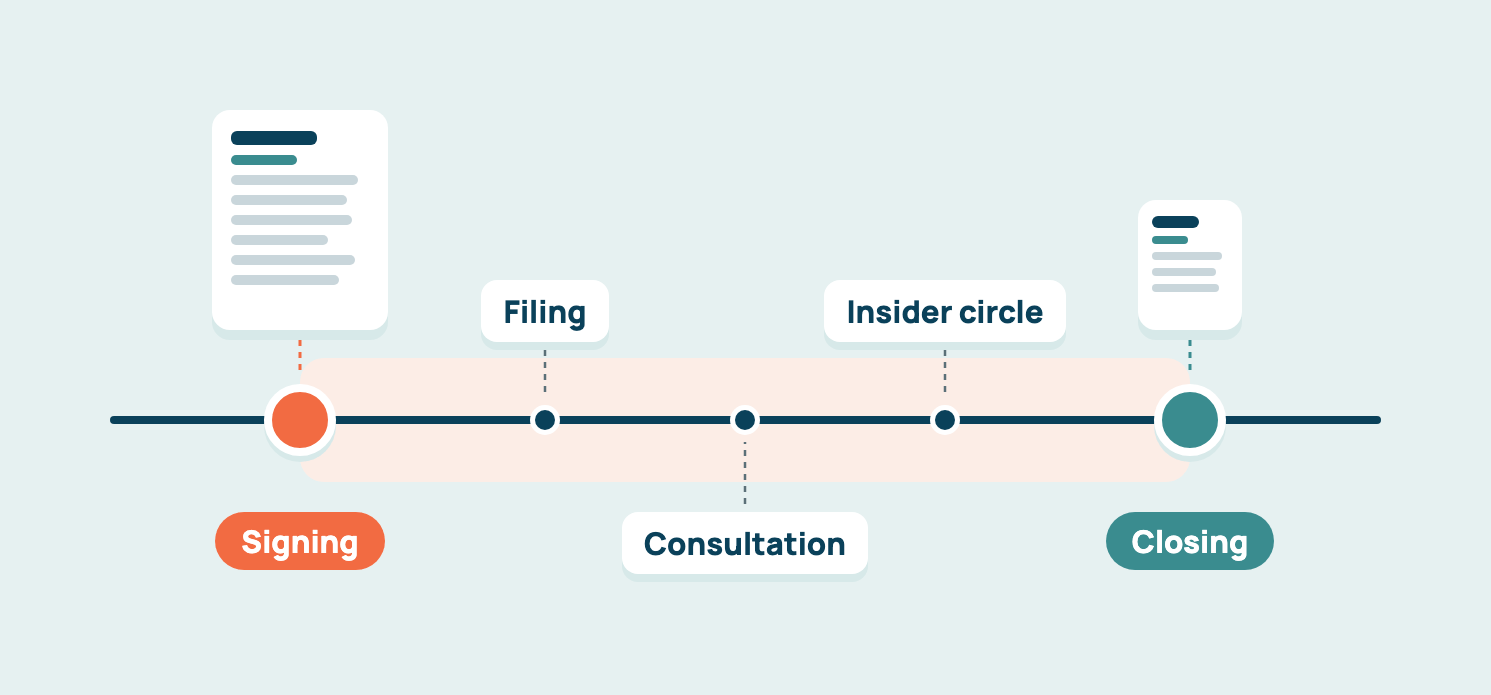
A deal has two news moments, the signing of the agreement and the closing of the transaction, and a private company can choose which one carries the announcement. Announcing at signing gives the company control of the story during the weeks when filings, consultations and customer conversations make silence difficult. Announcing at closing removes the risk of a deal that is announced and then fails, and it suits small transactions that close on the day they are signed.
The practical rule follows from the sections above. When a merger control filing, a consultation duty or a large circle of insiders makes the deal visible, announce at signing and confirm at closing with a second, shorter release. When signing and closing fall on the same day, announce once.
How to Write a Merger or Acquisition Press Release
A merger or acquisition press release states who is buying or merging with whom, whether the deal is signed or completed, and what changes for customers and employees, all in the headline and the first paragraph. The rest supports those facts.
Element
What it contains
Headline
Both company names and the verb: acquires, merges with, agrees to acquire
Lead paragraph
The parties, the nature of the deal, its status and the date
Rationale
One paragraph on why the two businesses fit, in concrete terms: markets, products, capacity
What changes
Brand, management, locations, customer contracts and contacts
Terms
Price if disclosed, or the sentence that financial terms were not disclosed, plus the conditions for closing
Quotes
One from each side, about the future of the business rather than the feelings of the speaker
About sections
A boilerplate for each company with comparable figures
Contacts
A media contact for each company and each main market
Private companies often keep the price confidential. Journalists accept this when the release gives other figures that show the scale of the deal: combined headcount, countries served, number of customers or production capacity. A press release with no figures at all rarely becomes a story.
The format follows the standard press release template, with one difference: two companies approve every word. Agree on the approval route and the final sign-off before the last night. If selected journalists receive the release in advance, agree on what a press embargo requires in writing and keep the embargo period short.
A press kit with executive photos, both logos and a one-page fact sheet answers most follow-up questions before they are asked.
Acquisition Press Release Template for a Private Company
The template below follows the element table. Replace the text in brackets and delete the lines that do not apply.
FOR IMMEDIATE RELEASE
[Buyer] Acquires [Target] to [one concrete result, for example: Enter the German Market]
[City], [date]. [Buyer], a [one-line description], has [signed an agreement to acquire / completed the acquisition of] [Target], a [one-line description] based in [city, country]. [One sentence on what changes for customers.]
[Rationale: why the two businesses fit, with two or three figures that show the scale of the deal, such as combined headcount, countries served or number of customers.]
[What changes and what stays the same: brand, management, locations, customer contracts and contacts.]
"[Quote about the future of the business]," said [name], [title] of [Buyer].
"[Quote from the founder or chief executive of the target]," said [name], [title] of [Target].
Financial terms of the transaction were not disclosed. [The transaction is subject to approval by (authority) and is expected to close in (period).]
About [Buyer]
About [Target]
Media contacts: [name, email and phone for each company and each main market]
For a merger, the headline verb changes to "merges with", and the lead names the combined company and its management.
Announcing a Cross-Border Merger or Acquisition
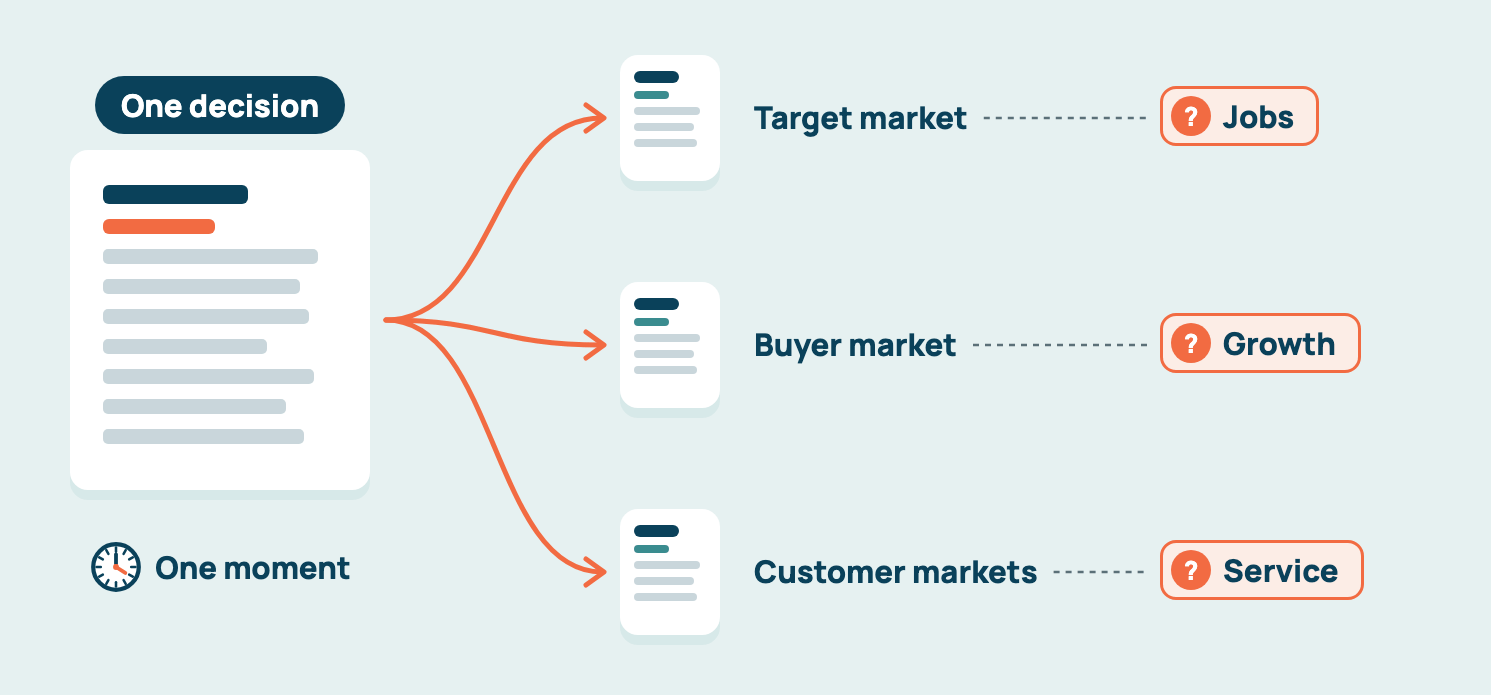
A cross-border deal is one decision and several stories, because each country asks a different question. Most deals need three versions of the announcement, each of which must be approved by both parties' legal advisers.
Version
The reader's question
Lead carries
Quote comes from
Language
Target's home market
What happens to jobs, the brand and local management?
The local consequence
The target's chief executive or local manager
Local language
Buyer's home market
Why this deal?
Growth and market entry
The buyer's chief executive
Local language
Markets where both companies have customers
Who serves us from now on?
Service, contracts and contacts
The executive known in that market
Local language and English
Two more things change in every version. Legal words are checked by a local reader, since a merger, an acquisition and a takeover are not the same thing in every language and some of these words carry a hostile tone. The contact person works in the local time zone.
Timing is one moment, not one local time. The release goes out at the same instant in every country: 09:00 in Amsterdam is 08:00 in London and usually 03:00 in New York. Employees in each country are informed in their own language before their local media, so every employee meeting is planned against that single time. The method for choosing which countries receive which version is described in press release targeting by country, region and global strategy.
Distributing an M&A Announcement with an Online PR Platform
On announcement day, press release distribution is a coordination task: one approved text, several language versions, several countries and a single release time. An online PR platform runs that sequence from one place. The release is written or edited, localized, assigned to countries, distributed to media outlets and followed by a coverage report.
B2Press is online PR software built for this workflow. Companies and their agencies use it to distribute press releases in over 75 countries and 24 languages through a press release distribution service organized in country PR packages, and media coverage is guaranteed according to the scope of the selected package. For a cross-border deal, this means the acquirer's market, the target's market and the main customer markets can receive their own version on the same day.
Conclusion
M&A communication for a private company is a sequence that the company designs itself: employees first, customers next, the media at an agreed time and every country in its own language. Write the leak plan before signing, decide between signing and closing, and give the press release the facts an editor needs. When the announcement is ready, you can submit your press release and choose the countries where employees, customers and partners will read about the deal.
Frequently Asked Questions
What is M&A communication?
M&A communication is the set of messages, documents and timings a company uses to announce a merger or acquisition and to explain what changes afterwards. It covers the period from confidential preparation before signing to the announcement, the closing of the deal and the first months of integration.
Does a private company have to announce a merger or acquisition?
A private company usually has no legal duty to announce a merger or acquisition to the public, because stock exchange disclosure rules apply to listed companies. The deal can still become visible through merger control filings, commercial register entries and employee consultation, so most private companies publish their own announcement.
Who should be told first about an acquisition, employees or the media?
Employees should be told first about an acquisition. Senior managers are briefed ideally two to three days before the announcement or the evening before. On the announcement day, employees of both companies hear the news from the chief executive, key customers and partners are contacted within the first hour, and the press release goes to the media at the agreed release time.
What should a merger or acquisition press release include?
A merger or acquisition press release should include both company names, the nature and status of the deal, the reason for it, what changes for customers and employees, the financial terms or a statement that they were not disclosed, the conditions for closing, one quote from each side, a boilerplate for each company and media contacts.
When should a merger or acquisition be announced, at signing or at closing?
A merger or acquisition is announced at signing when filings, consultations or a large number of insiders make the deal hard to keep confidential, and it is confirmed with a second release at closing. Small deals that are signed and closed on the same day are announced once, at closing.
How do you announce an acquisition?
You announce an acquisition in a fixed order. Senior managers are briefed first, ideally two to three days before the announcement or the evening before. On the announcement day, employees of both companies hear the news from the chief executive, key customers and partners are contacted within the first hour, and the press release goes to the media at the agreed time. A private company chooses that day itself, at signing or at closing.
What should a company say if an acquisition leaks before the announcement?
If nothing is signed, the company says that it does not comment on market speculation. If the agreement is signed, the parties bring the announcement forward and issue a short holding statement on the same day. Denying a signed deal is not an option, because the denial becomes a second story later.