Promote product launches, funding news, and innovations in 75+ countries by reaching top tech journalists and global publications.
Drive international attention to destinations, campaigns, and services by distributing news to relevant travel and lifestyle media worldwide.
Increase visibility of new products, campaigns, and brand stories by connecting with influential retail and consumer-focused media outlets.
Strengthen your crypto brand’s credibility through targeted PR in tech, finance, and blockchain media across global markets.
Expand your agency’s services with global PR distribution in 75+ countries, featuring guaranteed coverage, localized press releases, and white-label reporting for your clients.
Press Release Targeting: Country, Regional, and Global Strategies
Press release targeting determines how effectively your news travels across markets. Choosing between country-specific, regional, or global distribution depends on your goals and target audience. Selecting the right press release distribution packages ensures your announcement reaches the most relevant markets.
This guide explains how each targeting strategy works, when to use it, and how language, timing, and localization influence results.
What Is Press Release Targeting?
Press release targeting is the process of deciding where and how your announcement will be distributed. Instead of sending one release everywhere, targeted distribution focuses on the markets where the message is most relevant.
Why Press Release Targeting Matters
Effective targeting ensures your press release content reaches the audiences most likely to engage with it. When you focus on the right markets, every part of your PR effort becomes more strategic and impactful.
Key benefits of targeted distribution:
Higher pickup rates in relevant outlets, as journalists receive news tailored to their market.
Stronger credibility, thanks to localized, native-language coverage that feels authentic and trustworthy.
Better alignment with business goals, ensuring your PR activity supports market entry, expansion, or brand positioning.
More efficient budget use, avoiding unnecessary spending on markets where the news has limited relevance.
Country-Level Targeting in Press Release Distribution
Country-level targeting focuses on one specific national market. Consider how press release distribution can support precise national exposure.
This approach ensures the message aligns with that country’s cultural, economic, and media environment. Because the content feels relevant and localized, journalists view it as more credible and are more likely to cover it.
Examples
A Spanish fintech expanding into Germany distributes its release in German and English to meet local media expectations.
An EV manufacturer entering the UAE targets Dubai’s automotive and business outlets to build early awareness.
A food-tech company launching in Türkiye adapts the announcement with local data and Turkish-language quotes.
Advantages
Highly precise audience fit
Easier localization and cultural adaptation
Higher credibility with local journalists
Ability to tailor messaging to local regulations, trends, and pain points
Challenges
Limited visibility outside the chosen country
Requires professional translation and cultural adjustments
Media expectations vary significantly across markets
Regional Targeting in Press Release Distribution
Regional targeting covers several countries within the same geographic area. It works well when your story is relevant across neighboring or culturally aligned markets.
This method allows brands to communicate consistently while benefiting from shared trends, languages, or regional media behavior.
Examples
An energy company expanding across Africa distributes one coordinated release to major outlets throughout the continent.
A Korean gaming studio entering MENA publishes in English and Arabic, targeting Saudi Arabia, UAE, and Qatar.
A European SaaS provider launching new compliance features targets EU countries due to shared regulations.
Advantages
Efficient access to multiple markets
Scalable awareness across regions
More cost-effective than multiple country-by-country campaigns
Helps unify messaging for regional strategies
Challenges
Risk of the message feeling too general
Some countries may still require additional localization
Cultural and regulatory differences may still affect coverage
Global Targeting in Press Release Distribution
Global targeting is for announcements with international impact, explore press release packages designed to scale media coverage worldwide.
This approach ensures the story reaches journalists, analysts, and stakeholders worldwide, helping the brand strengthen its international presence.
Examples
A biotech company announces breakthrough clinical trial results and attracts coverage from global science and investor media.
Paribu Custody launches globally through B2Press and reaches international financial and technology outlets.
A multinational releases its annual sustainability report to position itself as a global ESG leader.
Strong network effects as global media amplify the story
Positions the company as an international brand
Helps attract global partners, customers, and investors
Challenges
Requires extensive translation and cross-market coordination
Less room for country-specific depth
Harder to tailor messaging for every region
More competition for global media attention
Language and Localization in Press Release Targeting
Journalists strongly prefer press releases written in their own language. Localization affects how credible, relevant, and newsworthy your announcement appears.
When a release follows local language norms, cultural expectations, and industry terminology, journalists are more likely to engage with it and consider it for coverage. This is why language strategy plays a central role in successful PR targeting.
Best practices for localizing press releases
Provide both English and the local language version.
Adapt quotes, job titles, and industry terminology to local norms.
Use professional translators instead of machine translation tools.
Localized press releases consistently secure more media coverage and stronger engagement than English-only campaigns.
Timing and Scheduling in Press Release Distribution
Timing is a crucial element of distribution. Even the strongest announcements can underperform if sent at the wrong moment.
Journalists work within strict schedules, and newsrooms follow predictable publishing patterns. Sending your release when media activity is low —or during major national events— can easily reduce visibility.
Tips for better timing
Avoid national holidays and major local events.
Consider newsroom working hours and time zone differences.
Use embargoes for sensitive, highly technical, or multilayered stories.
Platforms like Online PR Software B2Press help manage this process with flexible scheduling tools and embargo support aligned with journalist workflows.
Measuring the Success of Your Targeting
To understand whether your targeting strategy worked, you need to track both media performance and user behavior. Evaluating results across multiple indicators shows which markets engaged most and which messages resonated.
This analysis helps refine future campaigns, adjust targeting choices, and improve ROI over time.
Key metrics
Quality of media coverage (tier-1 vs. tier-2 outlets)
Geographic accuracy of media pickup
Referral traffic from published articles
Growth in branded and non-branded search queries in targeted markets
Each metric contributes to a clearer picture of how effectively your press release reached—and influenced—your audience.
How PR Platforms Support Targeting
Managing translations, media lists, and distribution across multiple countries can be time-consuming. Modern PR platforms simplify this by centralizing localization, scheduling, and media outreach under one system.
This ensures your release reaches the right journalists in the right markets without extra manual work.
What platforms like B2Press offer
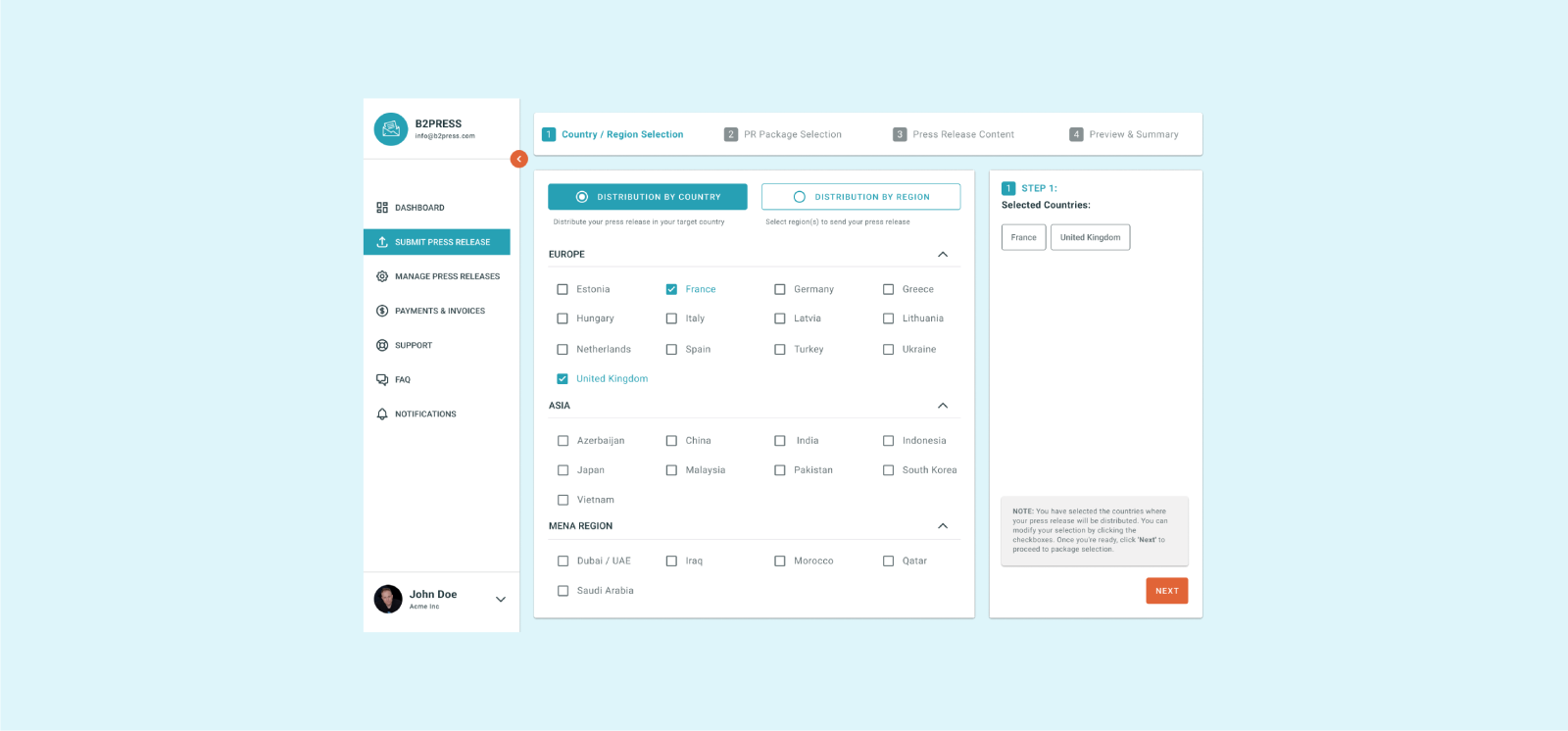
Country, regional, and global targeting options
Access to journalist databases and news agencies
Professional translation and localization services
B2Press, for example, provides guaranteed media coverage in 75 countries and distributes press releases in 24 languages, helping brands connect with relevant outlets worldwide.
Conclusion
Press release targeting turns a basic announcement into a strategic, high-impact PR effort. By choosing the right geographic approach—whether country-level, regional, or global—you ensure your message reaches the audiences that matter most.
Localization, language selection, and smart scheduling further increase your chances of earning quality media coverage. These elements help your story resonate with journalists, stand out against competing news, and generate stronger engagement.
Start distributing with B2Press and share your story with the right journalists in every market that matters — submit press release today and launch your campaign.
Frequently Asked Questions:
What is press release targeting?
Press release targeting is the process of selecting which markets, regions, or countries will receive your press release to maximize relevance and media pickup.
Is it better to target one country or go global?
It depends on your announcement. Local news works best with country targeting, while major launches or corporate milestones benefit from global distribution.
Why does language matter in PR?
Journalists are more likely to cover news written in their own language, making localization essential for strong results.
How do I choose the right timing for distribution?
Avoid holidays, consider time zones, and use embargoes for sensitive or complex announcements.