Promote product launches, funding news, and innovations in 75+ countries by reaching top tech journalists and global publications.
Drive international attention to destinations, campaigns, and services by distributing news to relevant travel and lifestyle media worldwide.
Increase visibility of new products, campaigns, and brand stories by connecting with influential retail and consumer-focused media outlets.
Strengthen your crypto brand’s credibility through targeted PR in tech, finance, and blockchain media across global markets.
Expand your agency’s services with global PR distribution in 75+ countries, featuring guaranteed coverage, localized press releases, and white-label reporting for your clients.
Renewable Energy PR: A Media Guide for New Energy Projects
Renewable energy PR is the work of turning a solar, wind, storage or grid project into news that journalists, local communities and investors want to read. It covers the whole life of a project, from permit application to first power, and it relies on press releases, local briefings and sourced data. This guide explains what makes an energy announcement newsworthy, how to reach local media before opposition forms, how to announce a project that spans several countries, and how to write climate claims that survive a journalist's check.
What Is Renewable Energy PR?
Renewable energy PR, also called clean energy PR or renewable energy public relations, is public relations for companies that develop, build, finance or supply renewable energy projects. The audience is wider than in most industries. A developer has to persuade a planning committee, reassure neighbors, inform a grid operator, attract lenders and recruit workers, often in the same month, and the press is the one channel that reaches all of them at once.
The editor's question behind every energy story is the same: what changes for my readers? A trade journalist wants capacity, technology and counterparties. A regional reporter wants land, traffic, jobs and tax revenue. A business editor wants the investment figure and the names behind it. One project can answer all three, but not with the same press release.
Cleantech PR is the neighboring field to renewable energy PR. It covers the technology companies that sell into energy projects, and its news is led by products and funding rounds. Renewable energy PR, as used in this guide, is led by projects: the news fact is a plant, a permit, a contract or a megawatt figure.
Why Energy Projects Struggle for Media Attention
Energy projects struggle for attention because the sector's success has made the single project ordinary. The world added 692 GW of renewable capacity in 2025 and reached 5,149 GW in total, with renewables taking 85.6 percent of all new power capacity that year (IRENA, Renewable Capacity Statistics 2026, April 2026). Renewables also generated more electricity than coal for the first time in a century, 33.8 percent against 33.0 percent, and solar and wind together covered 99 percent of the growth in demand (Ember, Global Electricity Review 2026, April 2026). A new 50 MW solar park is part of a trend that editors have already covered.
The second problem is that the energy news that does get written is often about delay. The International Energy Agency (IEA) expects 4,600 GW of new renewable capacity between 2025 and 2030, yet it cut its forecast by 5 percent in one year and its United States forecast by almost half, pointing to policy uncertainty, permitting timelines and grid connection (IEA, Renewables 2025, October 2025). In a survey of utility-scale developers by Lawrence Berkeley National Laboratory, roughly a third of wind and solar siting applications from the previous five years had been cancelled, with local ordinances and community opposition among the leading causes (Berkeley Lab, 2024).
Both problems point the same way. The coverage a project earns is decided early, locally and with evidence, long before the plant produces its first kilowatt hour.
What Makes an Energy Announcement Newsworthy
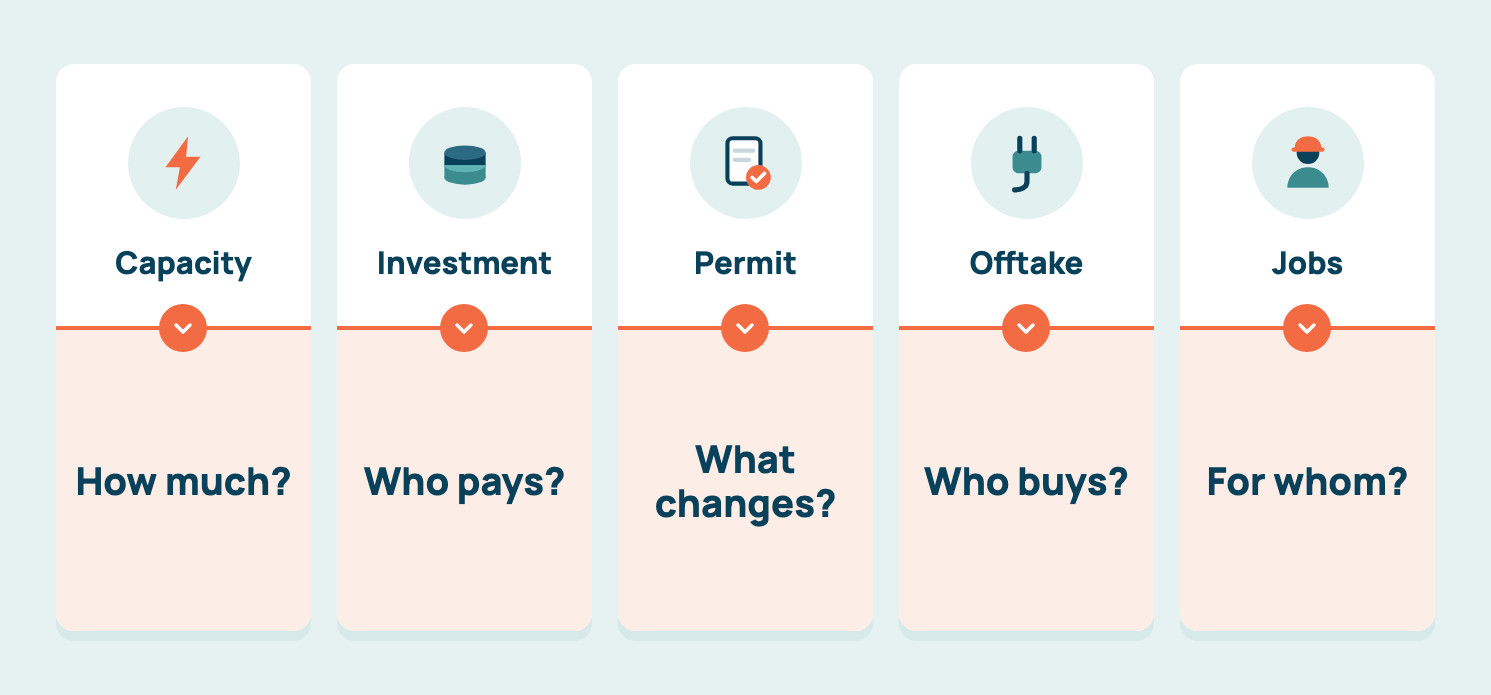
An energy announcement is newsworthy when it contains a fact that did not exist yesterday and that changes something for a defined group of readers. Capacity alone rarely qualifies. The table lists the announcement types that energy companies send most often and the question an editor asks before running each one.
Announcement
The news fact
The editor's question
Capacity and commissioning
MW or MWh in operation, first power date, what it replaces
How much, where, and what does it displace?
Investment and financing
Amount, lenders or investors, financing close, use of funds
Who is putting money in, and why now?
Permits and planning
Approval granted, conditions attached, next step, timeline
What happens on the ground, and when?
Offtake and power purchase agreements (PPAs)
Buyer, volume, contract term, what the buyer does with the power
Who buys this power, and what does it mean for them?
Jobs and local supply
Construction and operating jobs, local contracts, training places
How many, for how long, and for whom?
Technology milestones
First use of a technology in a market, measured performance
Is it really the first, and how is it measured?
Partnerships
Who does what, the first joint project, the combined scope
What is new that neither party could do alone?
Two rules apply to all of them. The first is to translate the unit: megawatts mean little to most readers, while a household equivalent means something, provided the release states the consumption figure and its source. The second is to name the counterparties. A release that speaks of a leading European utility has no news fact, because the fact was the name.
A financing close follows the format of a funding announcement press release: amount, participants, structure and what the money builds. A technology first follows the logic of a product launch and needs a measurement, a comparison and a third party who can confirm it, as described in how to get media coverage for a product launch.
Local Media First: Permits, Community Acceptance and Jobs
Local media decide whether an energy project is welcomed or fought, so the first announcement should go to them at the application stage rather than at the start of construction. Most developers in the Berkeley Lab research still preferred to decide on a site, announce it and then defend it, and the public typically heard about a project only after its location and design were fixed. That sequence hands the first story to the opposition.
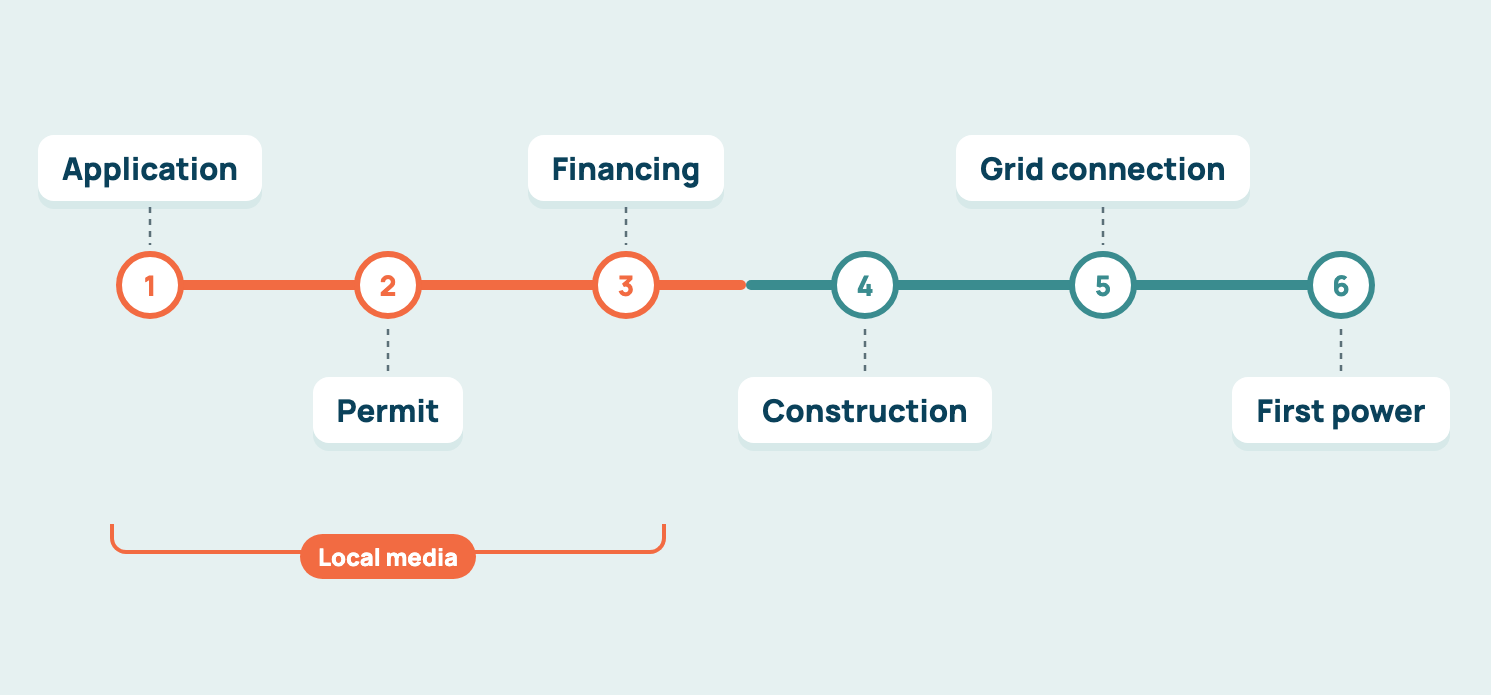
Each project has six news moments: application, permit, financing, construction start, grid connection and first power. Treating them as six releases gives a regional paper six reasons to write and gives residents six chances to hear from the company instead of from a campaign group.
A local release answers local questions: how much land is involved and what it was used for, what changes for traffic during construction and for how long, how many jobs the build creates and how many remain once the plant runs, what the municipality receives in taxes or community payments, and who to call. The spokesperson is the site manager or the local project lead rather than the group CEO, and the contact details are local.
Information sessions belong in the release calendar. The invitation is news for a community paper, and the summary afterwards, with the objections raised and the answers given, is a second story. A company that publishes the hard questions itself keeps control of the record.
Announcing Multi-Country Energy Projects
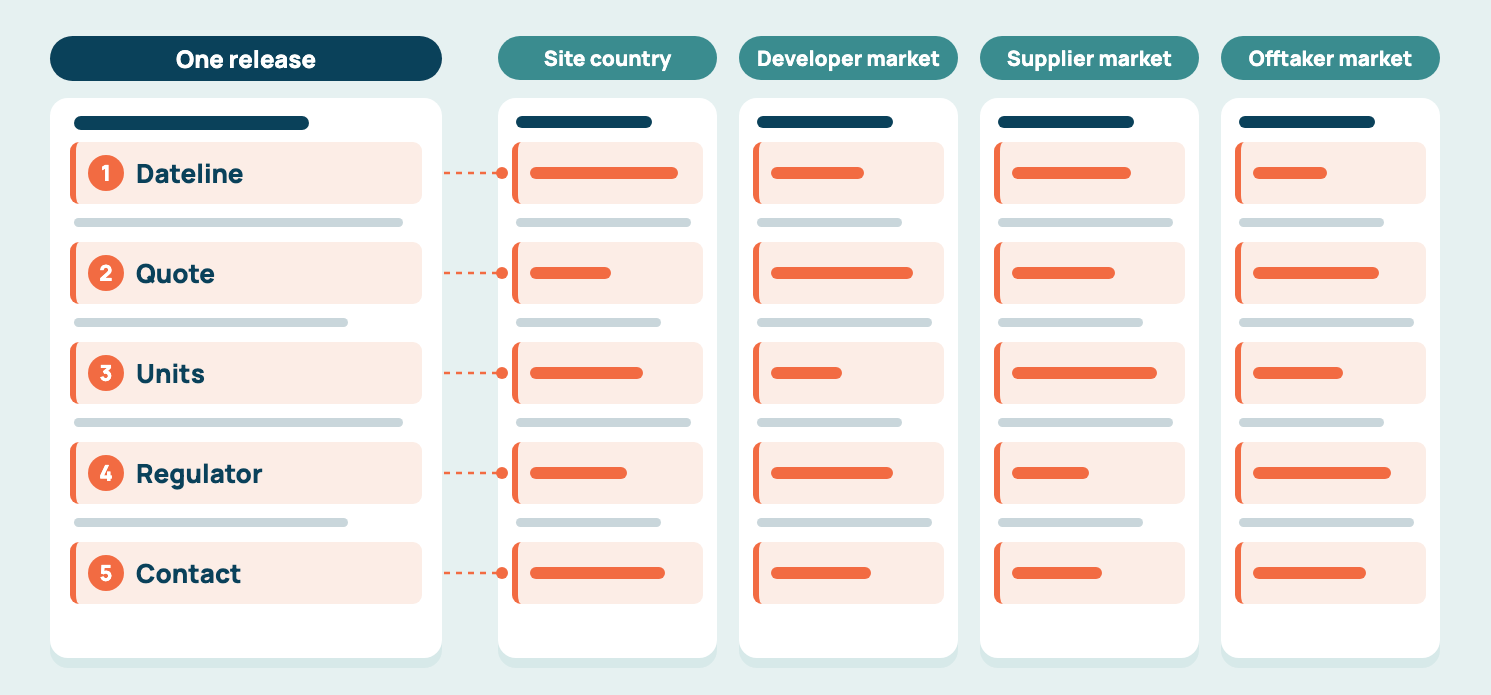
A project with a developer in one country, a module supplier in a second, an offtaker in a third and a site in a fourth carries four different stories, and one English release serves none of them well. The site country wants the local facts. The developer's home market wants the investment and the pipeline. The supplier's market wants the order size and the technology. The offtaker's market wants to know what the power is for.
Five lines change in each version of the press release: the dateline and lead carry the local angle; the quote comes from the person relevant to that market; units, currency and regulatory terms appear in local form; the grid operator or regulator is named correctly; the media contact sits in the local time zone. Timing follows the strictest market. A stock exchange disclosure or a regulator's publication sets the release time for everyone, so check what a press embargo requires and align the time zones before anything goes out. The method for deciding which countries get which version is covered in press release targeting by country, region and global strategy.
Translation is the smallest part of the job. A press release built around a European subsidy scheme means little in a market without one, and a household equivalent calculated with US consumption data has to be recalculated for every country.
Greenwashing Risk: Evidence Language for Energy Claims
The fastest way to lose an energy story is a claim the journalist cannot verify. Energy press releases draw more scrutiny than most because the vocabulary is loaded: green, clean, carbon neutral, sustainable. In the European Union, Directive 2024/825 restricts generic environmental claims that are not backed by recognized performance, and member states apply it from 27 September 2026, which puts the burden of proof on the company that writes the release.
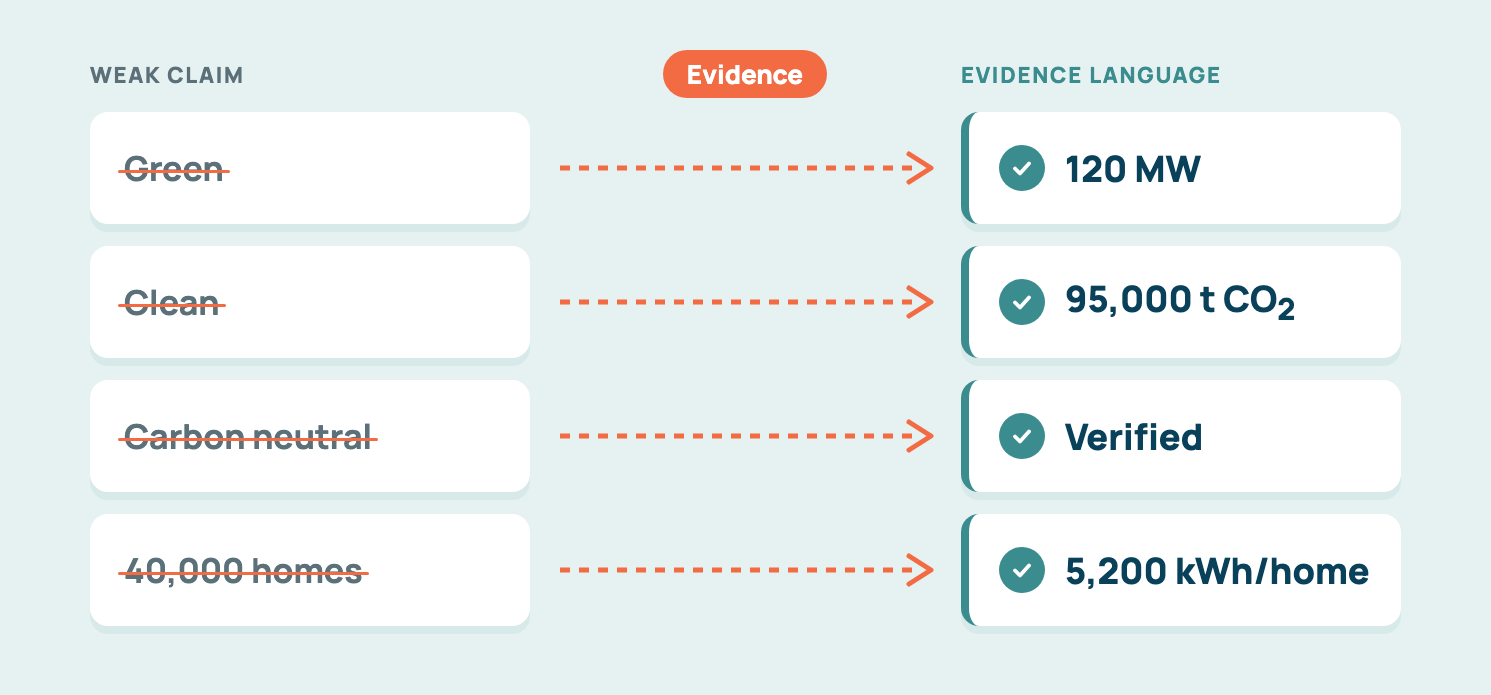
The remedy is to replace adjectives with measurements and to name the method. The figures below are illustrative.
Weak claim
Evidence language
A green energy project
A 120 MW solar plant with an expected output of about 210 GWh a year
Clean power for the region
Displaces about 95,000 tonnes of CO2 a year, calculated with the national grid emission factor for [year], published by [source]
Carbon neutral operations
Scope 1 and 2 emissions of [X] tonnes in 2025, reduced by [Y] percent since [base year], remainder offset under [named standard], verified by [auditor]
Powers 40,000 homes
Enough for about 40,000 households at an average consumption of 5,200 kWh a year, per [statistics office, year]
A sustainable supply chain
Modules sourced from suppliers audited under [standard] in [year]
Journalists also check what a release leaves out. Where a project replaces farmland, crosses a bird corridor or depends on a subsidy, say so and say what is being done about it. A paragraph of acknowledged limits reads as credibility; a release without one reads as advertising.
ESG and Sustainability Reports as a Media Topic
The publication of a sustainability report rarely earns coverage on its own. The number that changed inside it does. Editors receive hundreds of ESG reports a year, and the question they ask is what moved since last year. The release around a report therefore leads with one movement: emissions down 18 percent against a stated base year, a renewable share target met two years early, or a target missed and the reason given.
Three elements make an ESG press release usable. (1) The base year and the method, so the figure can be compared. (2) Third party assurance, with the assurer named. (3) A forward number, because a target is a promise the journalist can return to next year. Companies reporting under the EU's corporate sustainability reporting rules already hold this data in structured form. The PR task is to pick the one data point an editor can turn into a headline. This is the energy sector's version of data-driven PR, and the same rule holds: publish the dataset or the method alongside the claim.
Investor relations and PR publish on the same day with the same figures; a press release that differs from the investor presentation by a single decimal will be noticed, and the correction becomes the story.
Distributing Renewable Energy News with an Online PR Platform
Once the news fact, the local version and the evidence are in place, distribution becomes a workflow problem: the same announcement has to reach trade and business media as well as regional outlets in several countries at once, and the company needs to see what was published where. An online PR platform handles that sequence from one place: the release is written or edited, localized, assigned to countries and distributed to verified media outlets, and the coverage is reported back.
B2Press is online PR software built for this workflow. Energy companies and their agencies use it to distribute press releases in 75+ countries and 24 languages through a press release distribution service that runs on country PR packages, and media coverage is guaranteed according to the scope of the selected package.
B2Press editors check each release against the standard press release template before distribution, which catches a missing dateline or an unsourced household figure before a journalist does. The global media reach page lists the markets and media types available in each country, which matters when a project is announced in four of them on the same morning.
Conclusion
Renewable energy PR works when a company treats a project as a sequence of verifiable news facts rather than a single launch. Announce at the application stage, speak to local media in local terms, give each country its own version, and replace every green adjective with a measured figure and a method. When the next announcement is ready, you can submit your press release and choose the countries where the project, its investors and its buyers will read about it.
Frequently Asked Questions
What is renewable energy PR?
Renewable energy PR is public relations efforts for companies that develop, finance, build or supply solar, wind, storage and other renewable energy projects. It uses press releases, local briefings and sourced data to inform journalists, communities, regulators and investors at each stage of a project, from permit application to commissioning.
How does PR work for renewable energy projects?
PR for a renewable energy project follows the project timeline. The company announces the application, the permit, the financing, the construction start, the grid connection and the first power as separate news items, each with a local spokesperson, local facts and sourced figures. Local media come first because planning decisions and community acceptance are made locally.
When should a renewable energy project be announced to the media?
A renewable energy project should be announced when the permit application is filed, not when construction starts. An early announcement lets residents and local journalists hear the facts from the company, leaves less room for misinformation and gives the project several later news moments to build on.
What is the difference between renewable energy PR and cleantech PR?
Renewable energy PR is led by projects: the news is a plant, a permit, a contract or a capacity figure. Cleantech PR is led by products: the news is a technology, a funding round or a customer win for a company that sells into energy projects. Both follow the same evidence standards for environmental claims.
How do you avoid greenwashing in an energy press release?
Replace general words such as green, clean or carbon neutral with measured figures, state the calculation method and the source of any emission factor, name the third party that verified the data, and acknowledge the limits of the project. In the EU, Directive 2024/825 restricts generic environmental claims from September 2026, so unsupported wording also carries a legal risk.