Promote product launches, funding news, and innovations in 75+ countries by reaching top tech journalists and global publications.
Drive international attention to destinations, campaigns, and services by distributing news to relevant travel and lifestyle media worldwide.
Increase visibility of new products, campaigns, and brand stories by connecting with influential retail and consumer-focused media outlets.
Strengthen your crypto brand’s credibility through targeted PR in tech, finance, and blockchain media across global markets.
Expand your agency’s services with global PR distribution in 75+ countries, featuring guaranteed coverage, localized press releases, and white-label reporting for your clients.
Do You Need Arabic Press Releases for Successful PR in the Gulf Countries?
Do brands need Arabic press releases to succeed in the Gulf Countries or is English enough?
This is one of the most common questions asked by companies planning PR activity in the GCC. The answer depends on audience, country and purpose but in most cases, relying on English alone limits reach and media pickup.
This guide explains how language actually works in Gulf media, when Arabic is required, when English can work and how to choose the right language strategy for PR in the GCC.
Why Language Choice Matters in GCC PR
The Gulf Countries operate in a bilingual environment but bilingual does not mean equal.
Arabic remains the primary language for local credibility, institutional trust, and regional distribution. English is widely used but mostly within international, corporate and expat-facing media.
Brands that treat language as a tactical afterthought often struggle with low pickup rates, limited syndication and weak visibility beyond a narrow audience segment.
Understanding how language functions across GCC media is a prerequisite for effective PR.
Arabic vs English Media Usage in the Gulf Countries
Which language dominates Gulf media outlets
Arabic dominates the majority of local and regional news platforms across Saudi Arabia, Kuwait, Oman, and Bahrain. English-language outlets are influential, particularly in the UAE and Qatar but they represent only part of the media ecosystem.
Arabic-language media typically drives:
Regional syndication through news agencies
Broader pickup across country-level portals
Stronger engagement from local journalists
English-language media mainly serves:
International business audiences
Expat communities
Investor and corporate communications
Country-specific language differences
Language balance varies by country:
Saudi Arabia is Arabic-first
UAE supports bilingual publishing but Arabic increases regional reach
Qatar and Kuwait are mixed, depending on topic
Oman remains largely Arabic-focused
Treating the GCC as a single language market is a common mistake.
Do You Need Arabic Press Releases in the Gulf?
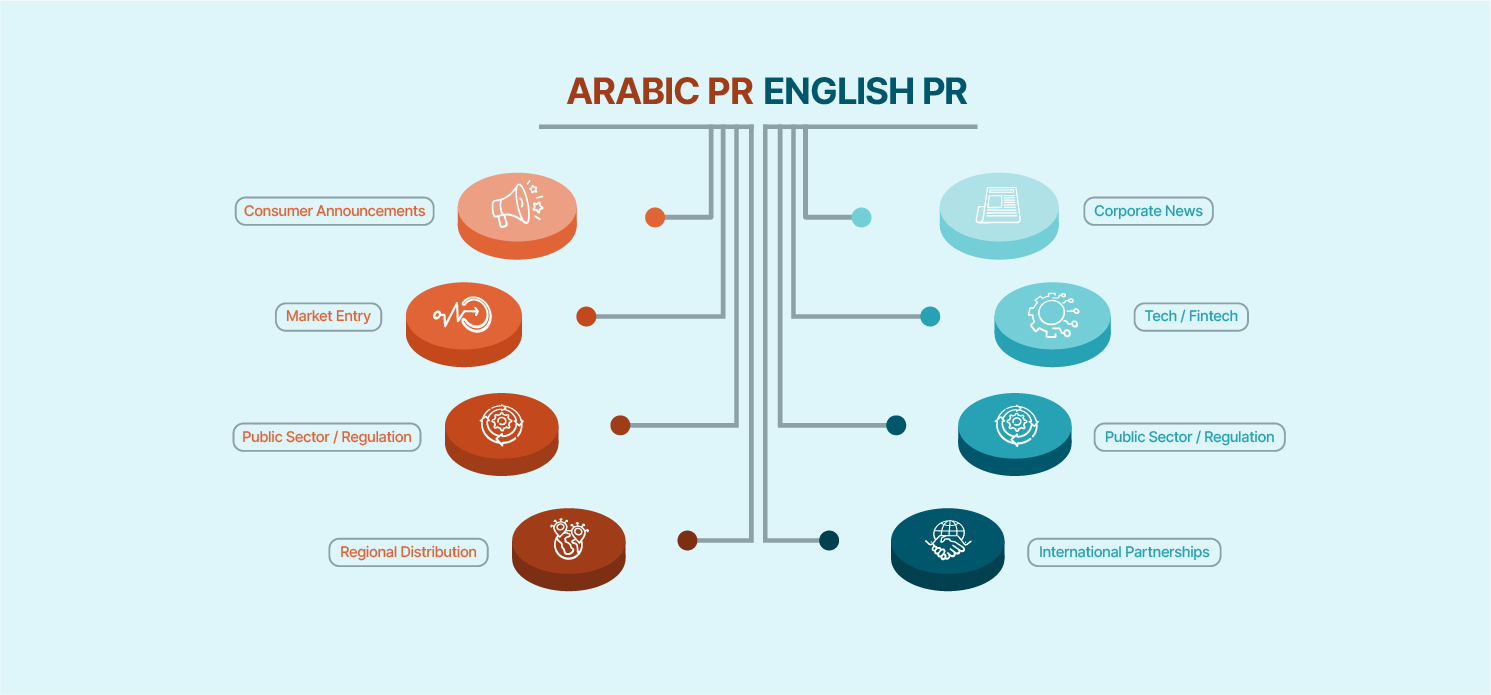
When Arabic is essential
Arabic is strongly recommended when PR involves:
Consumer-facing announcements
Market entry or expansion
Public sector, infrastructure or regulation-adjacent topics
Regional distribution across multiple Gulf countries
In these cases, English-only releases often fail to reach local media lists or are deprioritized by editors.
When English may be sufficient
English can work for:
Global corporate announcements
Technology and fintech updates
Investor relations and earnings reports
International partnerships with limited local relevance
Even in these scenarios, English typically reaches a narrower audience compared to Arabic or bilingual distribution.
English-Only PR in the GCC: Common Limitations
Brands that rely solely on English frequently encounter:
Low pickup outside Tier 1 English outlets
Limited regional syndication
Reduced trust among local editors
Missed visibility in Arabic-first portals
This does not reflect content quality but rather structural language preferences within Gulf media.
English-only PR is a strategic choice that should be justified, not assumed.
How to Choose the Right Language for GCC PR
Step 1: Define the target audience
Ask who the message is for:
Local consumers
Government or institutional stakeholders
International partners or investors
Audience definition is the strongest predictor of language success.
Step 2: Consider the industry
Language expectations differ by sector:
Finance, energy, infrastructure: Arabic or bilingual
Retail, lifestyle, FMCG: Arabic required
B2B technology: English acceptable, Arabic improves reach
Step 3: Assess geographic scope
Single-country campaigns may allow more flexibility. Multi-country GCC campaigns almost always perform better with bilingual or Arabic-first distribution.
How Arabic Localization Improves Media Pickup in the Gulf
Arabic-localized content aligns better with how news travels in the GCC.
Benefits typically include:
Higher acceptance by regional news agencies
Broader redistribution across local portals
Increased credibility among journalists
Improved visibility in Arabic-language search environments
Localization directly influences not only publication volume but also where and how content appears.
Best Practices for Arabic Localization in PR
Translation vs localization
Literal translation is rarely effective. Localization requires adapting tone, structure and terminology to regional norms.
Key adjustments include:
Formal headline structure
Contextual phrasing rather than promotional language
Proper use of titles, institutions and geographic references
Common localization mistakes
The most frequent issues include:
Direct translation of Western idioms
Informal or overly promotional tone
Ignoring country-specific terminology
Treating Arabic as a secondary version
These errors reduce credibility and limit media interest.
Should You Use Arabic and English Together?
For many brands, bilingual PR offers the most balanced approach.
Using both languages allows organizations to:
Reach local and international audiences simultaneously
Maintain message consistency across markets
Maximize pickup without narrowing audience scope
Bilingual distribution is especially effective for regional campaigns, partnerships and announcements with both local and global relevance.
Conclusion
Language choice is one of the most important strategic decisions in GCC PR.
Arabic plays a central role in credibility, distribution and visibility across the Gulf. English remains valuable but rarely sufficient on its own for region-wide impact.
Brands that evaluate language based on audience, industry and geography achieve stronger and more consistent PR outcomes in the Gulf Countries.