Promote product launches, funding news, and innovations in 75+ countries by reaching top tech journalists and global publications.
Drive international attention to destinations, campaigns, and services by distributing news to relevant travel and lifestyle media worldwide.
Increase visibility of new products, campaigns, and brand stories by connecting with influential retail and consumer-focused media outlets.
Strengthen your crypto brand’s credibility through targeted PR in tech, finance, and blockchain media across global markets.
Expand your agency’s services with global PR distribution in 75+ countries, featuring guaranteed coverage, localized press releases, and white-label reporting for your clients.
Research: From a Volume Economy to Data-Driven Journalism: The New Era in Digital Media (2023-2026)
Over the last 10 years, digital media has been under enormous volume pressure created by the cycle of “more content, more traffic, more advertising.” As the number of media outlets and digital content creators has increased, the advertising pie has grown, but it is now divided into increasingly smaller shares.
As a result, publishers operating with much smaller teams than before have to race against time under an information overload and produce more content to generate more revenue.
When artificial intelligence (AI), which makes content creation easier, and an increasingly difficult disinformation environment are added to this picture, the need for quality data and verified information continues to rise.
Newsrooms, business desks, publishers, and content creators see press releases that contain verified information and quality data as a “safe harbor.”
The massive growth in content and disinformation has pushed publishing to a point where it can no longer be managed solely through human labor. At the same time, editors want to use the advantage of being the “first to publish” by turning a press release into a live story within seconds.
FactGenie, an AI tool developed by Reuters News Agency, one of the world’s most influential and trusted sources for business and financial news, may be one of the clearest proofs of this need. (Reuters Institute - Journalism and Technology Trends and Predictions 2026)
Reuters News Agency automatically extracts key information from press releases sent by companies, enabling financial journalists to publish them quickly. Used by 150 journalists worldwide, this tool has also halved the time it takes to publish news other than company news.
The Reuters example supports the main argument of the research discussed in this article: the journalist’s role is shifting from writing from scratch to verifying incoming data and placing it in context.
At this point, data delivered through quality press release distribution enters the radar of AI tools and editors much faster.
As B2Press, through our professional editorial services, we provide journalists with the quality information and verified data they are looking for in a ready-to-use format.
Building on this context, and with the support of artificial intelligence, we selected two of the regions and three of the countries within our scope of service.
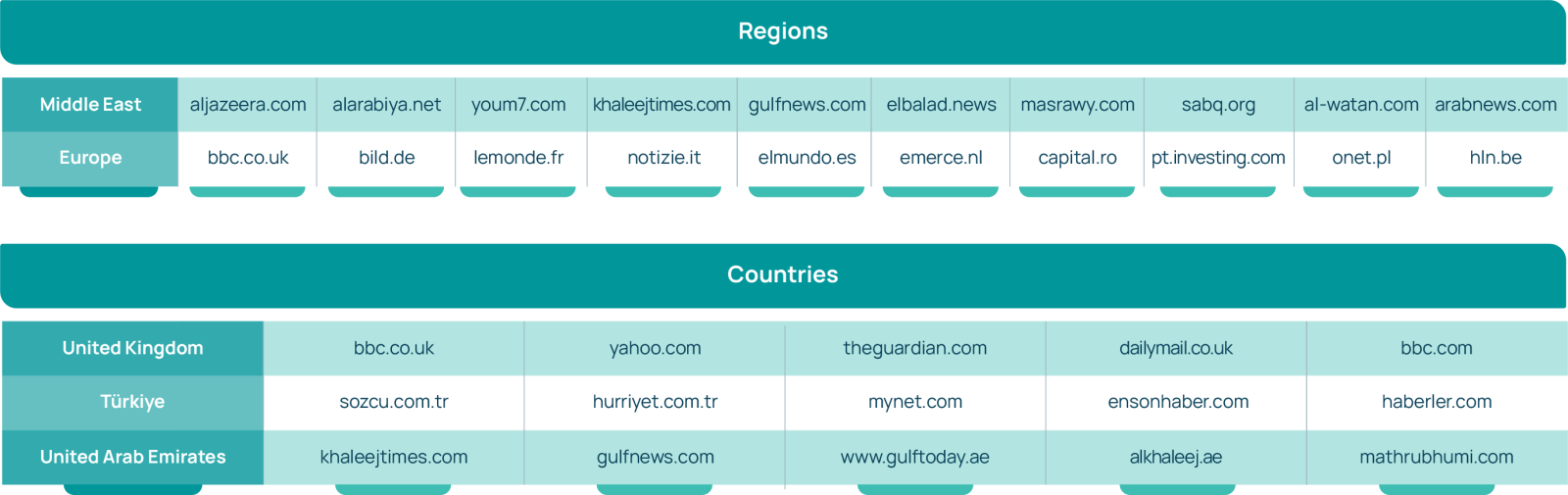
From a data journalism perspective, we examined the online performance of 30 leading publications across Europe, the Middle East, the United Kingdom, Türkiye, and the UAE between January 1, 2023 and March 31, 2026.
We also analyzed how much of the content creation in these publications were originated from press releases. Let’s evaluate the results of the B2Press Online News Analysis 2026 research together.
1. Total News Creation by Publication
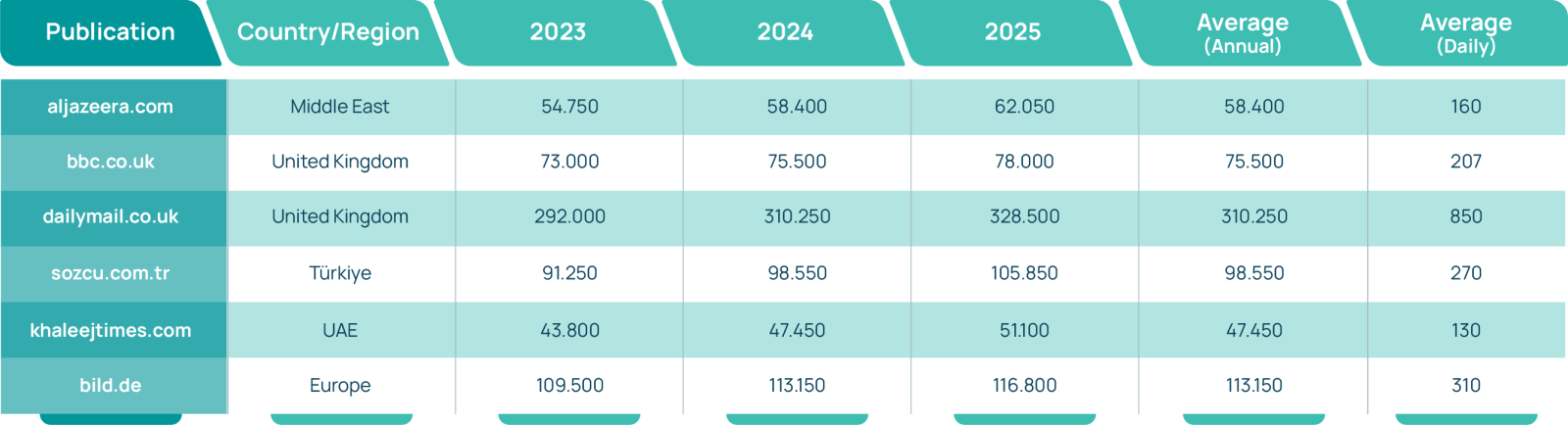
As part of the B2Press Online News Analysis 2026 research, we reviewed the selected leading publications from each region based on their total content creation performance between 2023 and 2025.
We assessed daily and annual average online news within the framework specified in the research methodology. The three-year trend points to an average annual increase of 7% in content volume.
2. Analysis of Selected Publications
To capture the most up-to-date picture, we focused on two different publications and included the first quarter of 2026.
We calculated brand-mentioned news, the press release coverage rate, and news using data.
BBC (United Kingdom)
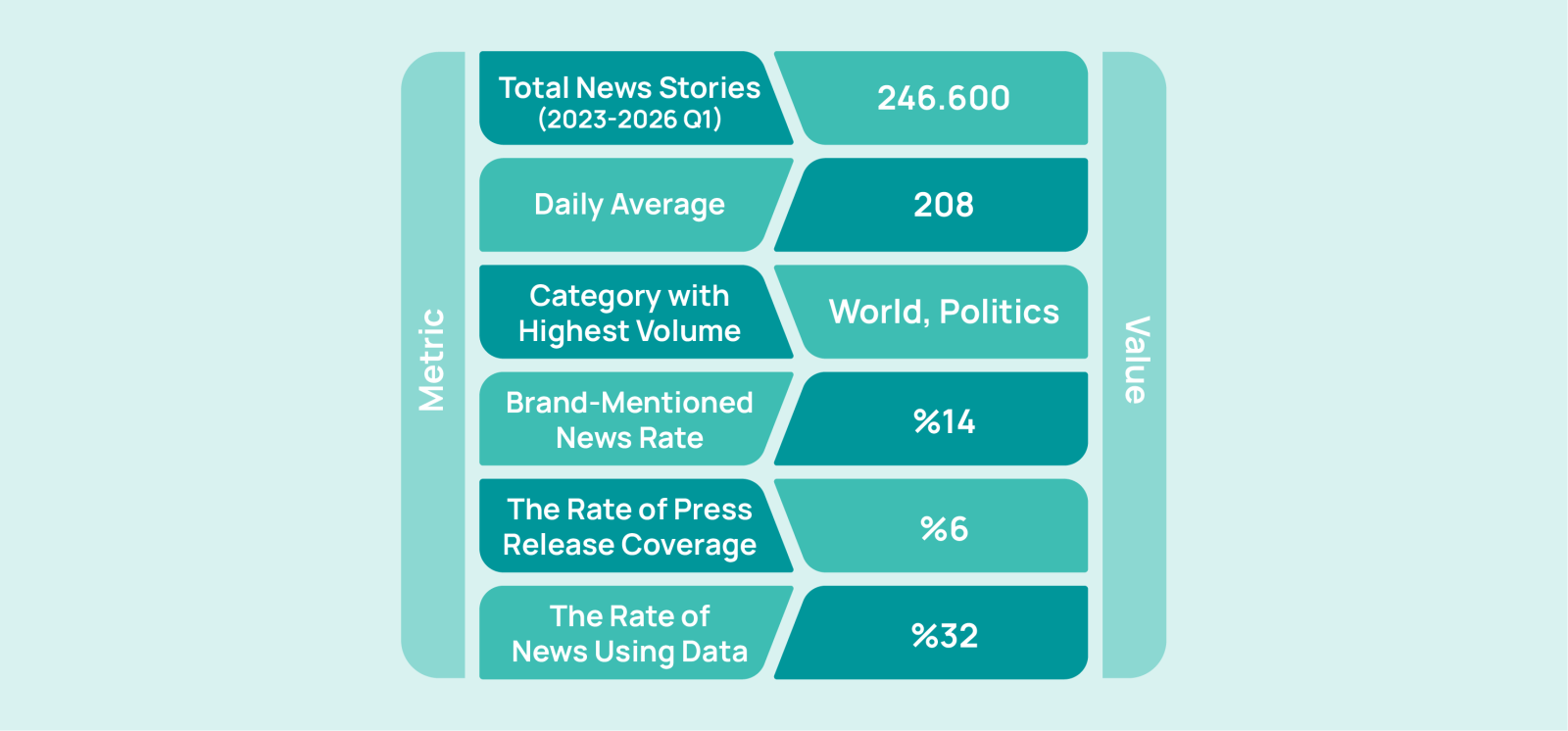
The BBC, the United Kingdom’s public service broadcaster, was one of the publications that kept press release coverage at the lowest level despite its high content volume.
Data was used in almost one in every three stories (32%), while this rate exceeded 40% in business and technology news.
The share of stories mentioning a brand remained at 14%, while the rate of stories we identified as potentially published as a result of press releases, through comparisons with other media outlets, was 6%.
We found that the BBC’s strategy is based on taking the data in a press release and reproducing it within its own context, rather than publishing the release as is.
Sözcü (Türkiye)
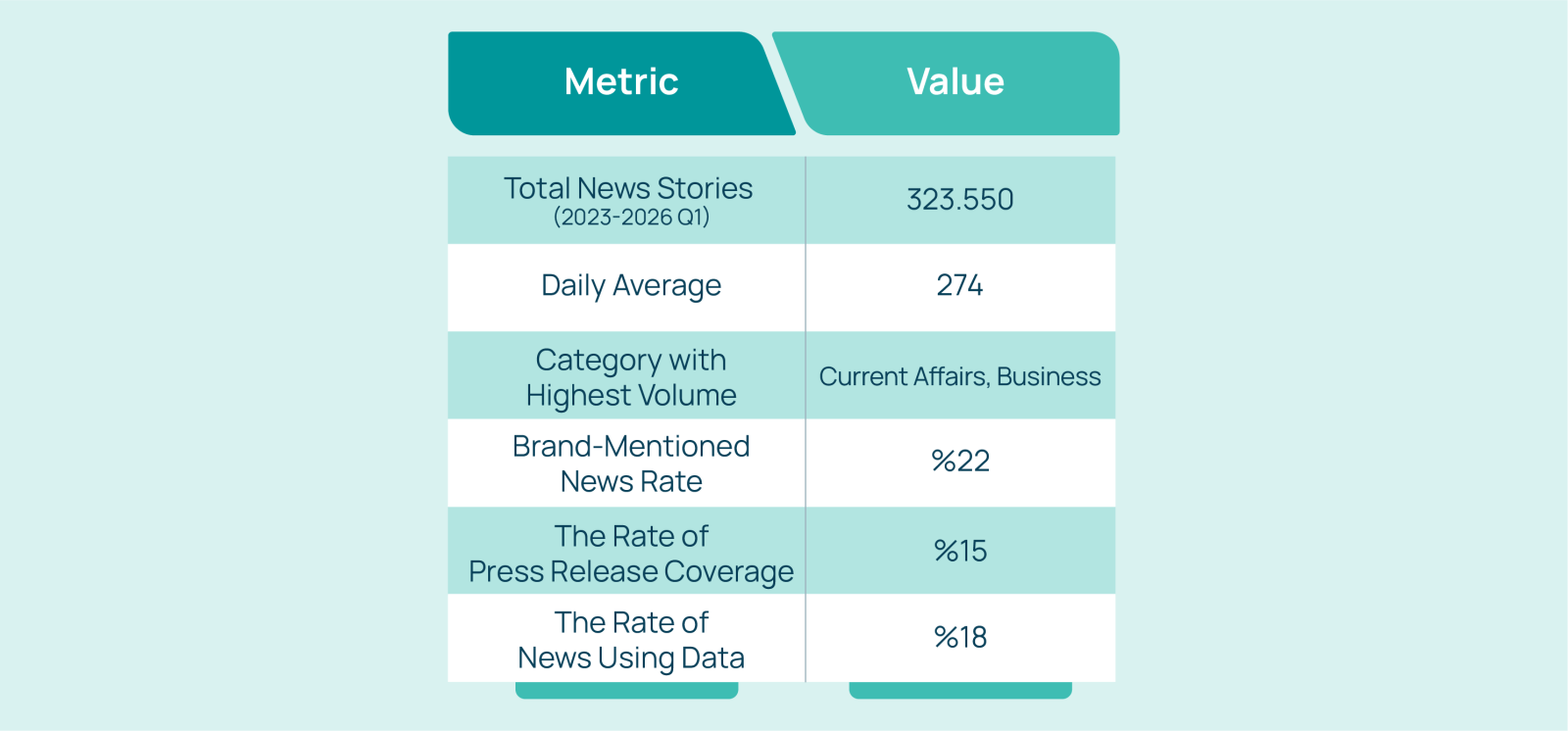
When we examined Sözcü, a newspaper published in Türkiye, we found that its publishing focus is mainly on current affairs and business.
Particularly in consumer-oriented business news, we observed that brand and data use are blended together.
The rate of stories that qualified as press release coverage was 15%, and these stories appeared especially in the “Business” and “Lifestyle” categories.
3. Category-Based Distribution and Brand Density
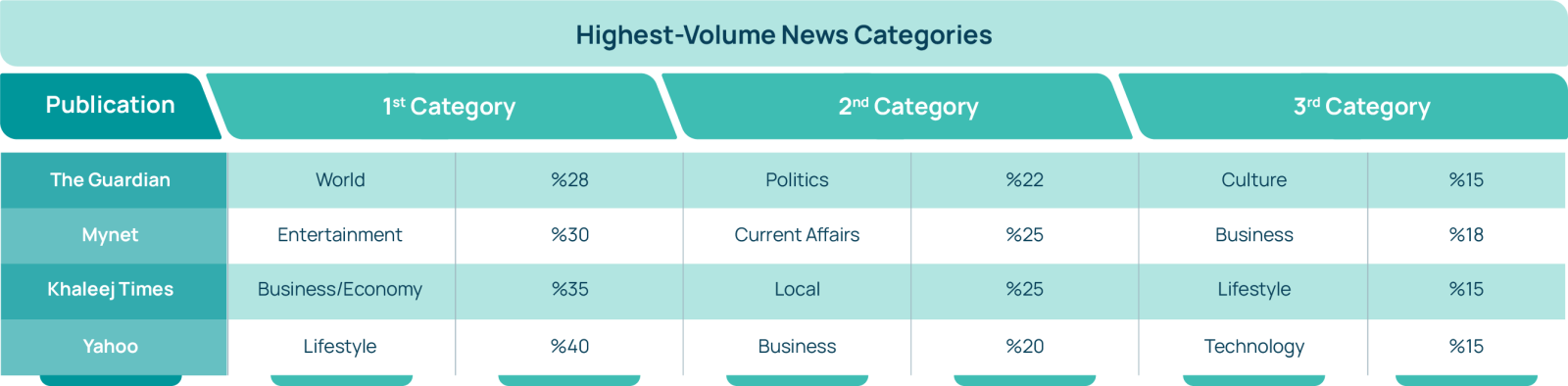
As part of the B2Press Online News Analysis 2026 research, we also examined in which categories publications produced the most news.
It is important to remember that this distribution is influenced not only by editorial preferences but also by the advertising revenue model.
In publications across the Middle East and the UAE, the business and economy category accounts for more than 30%, while over 60% of the stories in this category directly or indirectly include a brand.
In Europe, publications such as Le Monde and El Mundo continue to be dominated by politics and world news.
The technology category stands out as the area where brand visibility is highest.
4. The Relationship Between Data Use and Brands: How Press Releases Turn into News
One of the most striking findings of our research is the increasing acceptance of data-driven press releases in newsrooms.
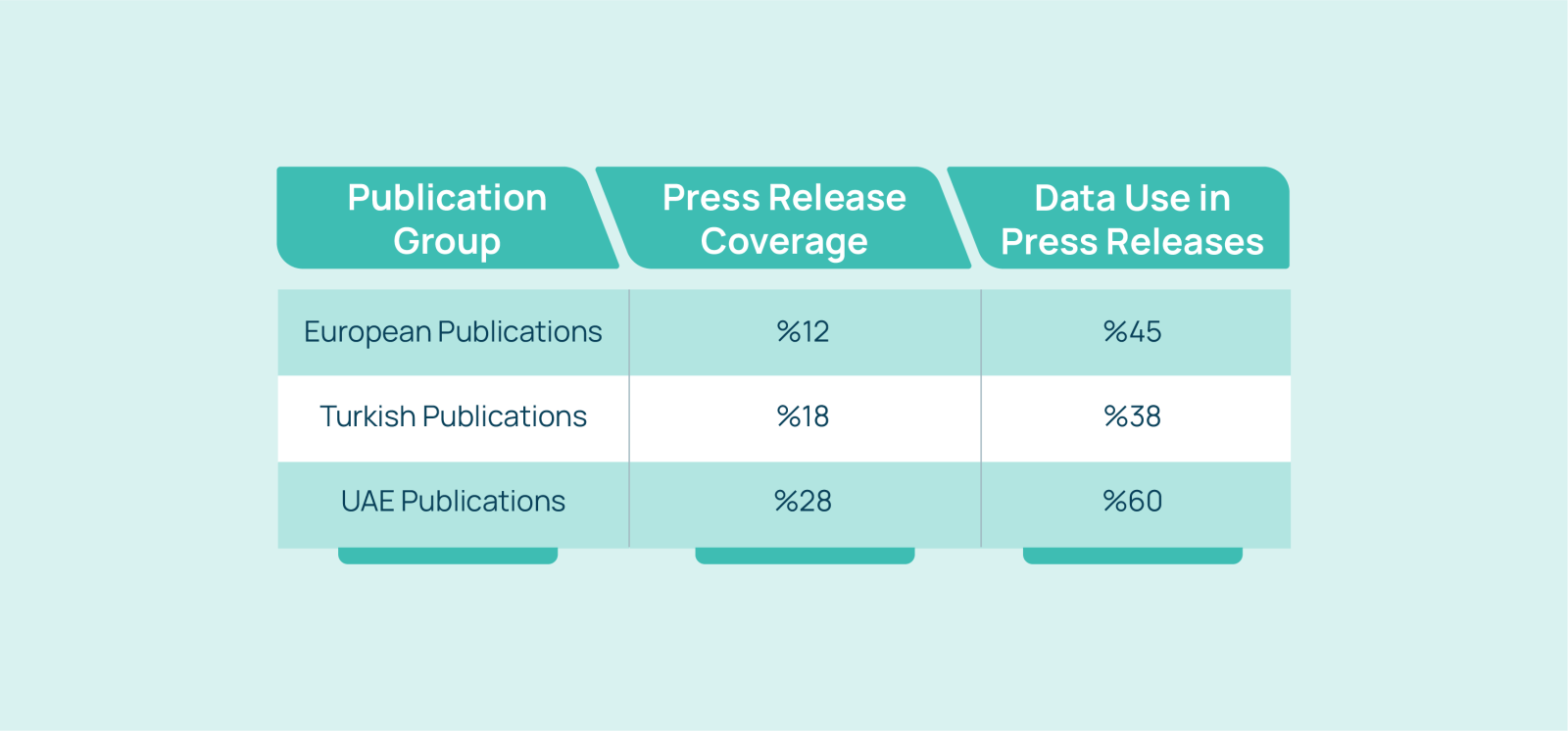
Publications in the UAE are the ones that turn press releases into news the most, while data use in these stories is also ahead of other publications. European journalists also favor the use of data.
Press release distribution has become a mechanism that meets the need for “fast and verified content” in digital media.
Especially in finance, technology, and healthcare, newsrooms evaluate a press release not as a PR text, but as a “ready-to-use, verified data package.”
5. Regional Comparison (2023-2026 Q1)
As part of the B2Press Online News Analysis 2026, we selected 2 regions and 3 countries.
Among them, the UAE stood out as the country with the world’s highest density of branded news.
It is also not far behind other countries in terms of data use.
In the country, press release distribution forms the backbone of business journalism.
In Europe and the United Kingdom, data-driven journalism is more prominent.
Brand content can appear on homepages only when supported by strong data, such as statistics, market share, or research.
Conclusion: Strategic Distribution in the New Media Ecosystem
The findings of the B2Press Online News Analysis 2026 research reveal a clear reality: online news creation is now a volume economy, and the way to avoid getting lost in this volume is through “data” and “verification.”
The most striking picture in the regional comparison comes from the UAE.
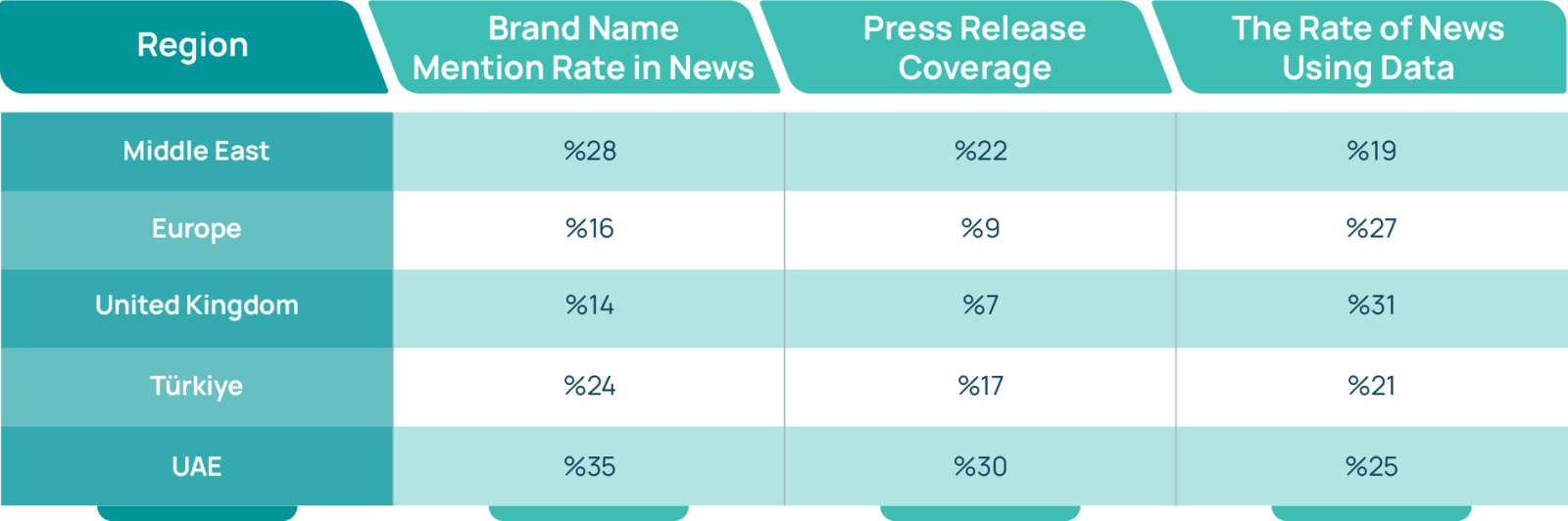
In the publications analyzed, the press release coverage rate reaches 30%. In other words, nearly one in every three stories in the UAE is directly or indirectly based on a press release.
The same rate remains at 7% in the United Kingdom and 9% in Europe. Türkiye is among them with 17%.
When viewed from the perspective of data use, the picture is reversed: 31% of news stories in United Kingdom publications contain data, while this rate remains at 25% in the UAE.
Europe ranks second with 27%.
This finding points to an important pattern: as data-driven journalism increases, the press release coverage rate decreases, but data-driven releases play a decisive role in crossing this threshold.
Over the three-year period covered by the research, press release coverage rates show a general upward trend.
Despite the average annual 7% increase in content volume, the rise in coverage rates indicates that the weight of press releases in editorial workflows is growing in direct proportion to volume pressure.
At the category level, technology stands out as the area where press release-originated news creation is most intense.
In finance news, data-driven releases are evaluated by editors as priority sources; content containing market share data, investment figures, and growth statistics reaches newsrooms as a “ready-to-use dataset.”
Healthcare remains the category with the highest need for verification, making source credibility and data quality critical.
In publications across the Middle East and the UAE, the business and economy category accounts for more than 30% of total content creation, and over 60% of the stories in this category directly or indirectly include a brand.
The structural conclusion we reached from the research as a whole is this: while newsroom resources are shrinking, pressure on them to create more is increasing.
In this paradox, press releases function not only as an announcement tool for newsrooms but also as a content source.
In an environment where the journalist’s role is shifting from writing from scratch to verifying incoming data and placing it in context, content that is supported by data, contains analysis, and is prepared to global standards can be directly integrated into the editorial workflow.
As we saw in the BBC example, even publications with high editorial standards take the data in a release and reproduce it in their own context, making the quality of the release decisive.
As a practical reflection of this transformation, brands need to go beyond creating good content.
It is also important for prepared content to reach the right media network, in the right technical format, and with speed.
Online PR platforms such as B2Press come into play at exactly this point with business models that make press release distribution possible across the world.
In the “high volume - limited time” equation we observed in the B2Press Online News Analysis 2026 research, data-driven content supported by a professional distribution network becomes one of the strongest assets in brands’ fight for digital visibility.
To summarize in one sentence: 2026 and beyond will be an era won not only by those who create the news, but by those who distribute data in the fastest and most reliable way.
Methodology and Data Reliability
This study was prepared by consolidating data obtained from sitemap scans, RSS feed analyses, Google News index samples, and digital media monitoring tools.
Within the scope of the research, more than 3 million URLs from 30 publications were examined.
For each publication, the daily average number of news stories was calculated using URLs selected through monthly sampling, and projections were made with a weighted average by year.
The URL structures, meta-tags, and keyword density of news stories were analyzed using NLP (Natural Language Processing)-based classification.
The presence of commercial organization names in news texts and the frequency of corporate announcement patterns such as “the CEO made the following statement,” “a launch was organized,” and “completed an investment round” were measured.
Numerical indicators, percentage expressions, financial tables, or research references were searched within the text.
Data obtained from publications with direct archive and API access, such as BBC, Al Jazeera, The Guardian, Sözcü, and Hürriyet, has high reliability.
For publications such as Bild, Le Monde, Khaleej Times, and Gulf News, index-based sampling and sitemap verification were conducted.
This research reflects the online performance of selected publications and does not claim to represent the media ecosystem of the relevant regions and countries.
The estimation model was used due to limited archive access for some local Arabic publications. The data regarding these publications should be considered indicative.
The threshold values used in determining press release reflection are based on the decision of the researcher and the results may differ partially with different methodological preferences.
Frequently Asked Questions
What should be considered when preparing a press release?
Brands should not limit their press releases to announcements only. They should provide verifiable data, concrete insight, sector context, and news value.
In fields such as finance, technology, and healthcare, editors prioritize content that is based on reliable sources and can be easily turned into news.
Are press releases important for journalists?
Yes. Press releases are important because they meet journalists’ need for fast, verified, and ready-to-use information.
Especially for publishers trying to manage high news volumes with small teams, data-driven releases serve as a reliable source that accelerates the editorial process.
Does a press release need to include data?
Press releases that include data, statistics, market share, investment amounts, growth rates, or research results are seen as more valuable by editors.
This is because such content offers not just an announcement, but a data package that can be turned into news.
What is the press release coverage rate in Türkiye?
According to the research, the press release coverage rate in Turkish publications was measured as 17%, while the brand-mentioned news rate stood at 24% and the rate of news using data was 21%.
This picture shows that stories based on press releases are visible in Türkiye, especially in the business and lifestyle categories.
Is content volume increasing in digital media?
Content volume in digital media is increasing due to rising competition, traffic pressure, the need to gain a larger share of advertising revenues, and publishers’ obligation to produce content more frequently.
According to the research, the selected publications recorded an average annual increase of 7% in content production between 2023 and 2025.
Which region offers the highest press release coverage?
According to the research, the UAE was the region with the highest press release coverage.
In the UAE publications analyzed, the press release coverage rate reached 30%.